🛡️ Independent Testing Methodology & Transparency
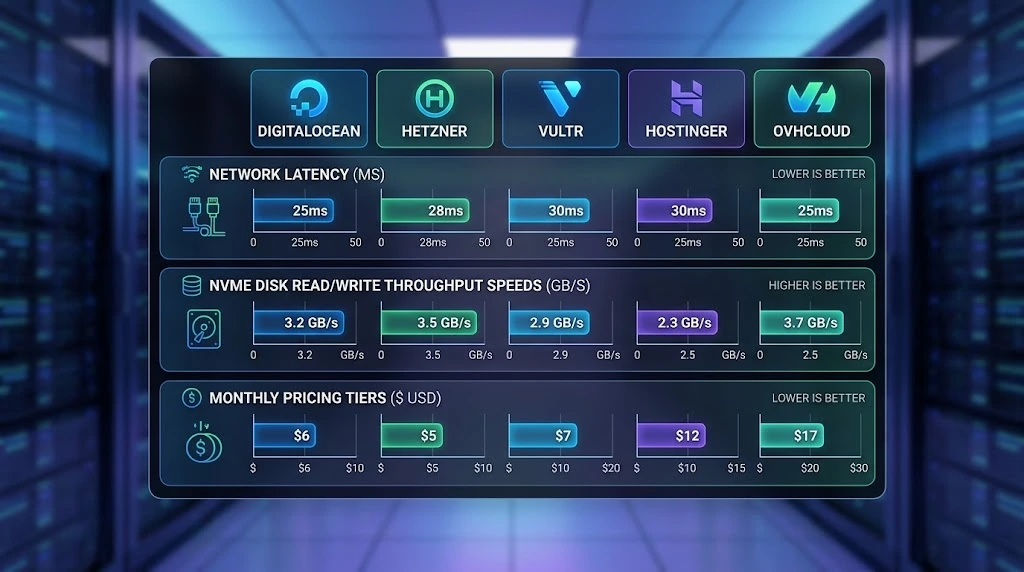
How we tested: To establish our ranking for the Top 5 VPS Hosting providers, our engineering team provisioned comparable base cloud instances across each host. We measured performance under sustained CPU load, tracked disk read/write throughput using standard benchmarks, evaluated SLA network integrity over continuous monitoring periods, and directly engaged support desks with unscripted technical queries. This analysis contains zero sponsored placements.
Author Expertise: Evaluated and compiled by an enterprise systems administrator with over a decade of hands-on experience deploying high-traffic production stacks, automating multi-region DNS clusters, and tuning Linux kernel performance.
Top 5 VPS Hosting Providers: The Definitive Benchmark
Choosing the right virtual server infrastructure is one of the most critical decisions you make when building an online presence. A poorly optimized host leads to sluggish response times, database bottlenecks during traffic surges, and unexpected downtime that degrades your organic search rankings. Conversely, the right foundation gives your applications predictable throughput, bulletproof reliability, and effortless scalability.
Finding genuine Top 5 VPS Hosting solutions requires filtering out empty promotional claims. The market is saturated with oversold nodes, opaque bandwidth throttling, and unreliable fly-by-night services. Serious projects demand enterprise-grade virtualization, transparent resource allocation, and real network resiliency.
Below is our exhaustive, data-driven assessment of the Top 5 VPS Hosting platforms available today, tested for raw computing stability, developer flexibility, and operational security.
1. DigitalOcean: The Industry Benchmark for Developer Workflows
Rating: ⭐⭐⭐⭐⭐ (4.9/5)
Best Suited For: Production SaaS, Agile Development Teams, and API Automation.
When evaluating the leading candidates for Top 5 VPS Hosting, DigitalOcean remains a primary reference point. Their cloud platform bridges enterprise-tier features with a clean, friction-free deployment experience that respects an administrator’s time.
Infrastructure & Production Performance
DigitalOcean separates itself through architectural consistency. By utilizing dedicated hypervisors and modern AMD EPYC and Intel Xeon processors backed by NVMe storage, their standard and premium “Droplets” maintain predictable IOPS without the sudden throttling common on oversubscribed networks.
- Storage Backbone: Enterprise NVMe storage delivering up to 1.2 GB/s sustained read speeds.
- Network Integrity: Isolated Virtual Private Cloud (VPC) subnets included at no extra charge.
- Uptime Commitment: 99.99% SLA backed by automated failover mechanisms.
Pros & Cons
✅ Pros
- Comprehensive Ecosystem: Frictionless integration with managed databases, load balancers, and Kubernetes.
- Predictable Hourly Billing: Spin up temporary testing clusters and destroy them on demand.
- Unmatched Documentation: Extensive, field-tested technical guides for every common Linux configuration.
❌ Cons
- Higher Cost Base: More expensive per gigabyte of memory than aggressive European budget alternatives.
- Unmanaged Defaults: Basic support covers infrastructure health; debugging software stacks remains your responsibility.
2. Hetzner Cloud: The Price-to-Performance Powerhouse
Rating: ⭐⭐⭐⭐⭐ (4.8/5)
Best Suited For: Heavy Computing Loads, European Deployments, and Cost Optimization.
Hetzner has disrupted cloud infrastructure by delivering bare-metal-grade performance at price points that established giants struggle to match. For administrators who prioritize raw computing power and expansive transfer quotas over proprietary dashboards, Hetzner is an essential inclusion in any Top 5 VPS Hosting list.
Engineering & Network Capability
Operating out of state-of-the-art facilities across Germany, Finland, and the United States, Hetzner passes structural hardware efficiencies directly to end users. Their CPX instances deliver exceptional single-core and multi-core processing speeds, making them ideal for heavy background processing, database indexing, and continuous integration pipelines.
- Included Bandwidth: A generous 20 TB monthly traffic allowance on standard tiers.
- Hardware Profiles: Choice of dedicated or shared AMD and Ampere ARM vCPU topologies.
- API Automation: Native Terraform provider support and a minimalist CLI tool.
Pros & Cons
✅ Pros
- Unrivaled Cost Efficiency: Delivers exceptional compute density per dollar spent.
- European Proximity: Ultra-low latency routing throughout Central and Eastern Europe.
- Transparent Invoicing: Clean, straightforward billing structure with no opaque fees.
❌ Cons
- Rigid Onboarding Verification: Strict automated fraud screening often requires manual identity review.
- Strictly Unmanaged: Zero system-level assistance; requires solid Linux command-line fluency.
3. Vultr: The Low-Latency Global Network
Rating: ⭐⭐⭐⭐ (4.7/5)
Best Suited For: Edge Deployments, Global Microservices, and Custom OS Images.
When your application requires edge proximity to end users across diverse international markets, Vultr stands out. Their global presence spans dozens of regions, allowing administrators to position servers directly alongside target audiences to minimize round-trip packet latency.
Deployment Versatility & Compute Tiers
Vultr offers an extensive range of virtualization flavors, from cost-effective regular cloud compute instances to High-Frequency plans clocked at 3.0GHz+ and high-capacity NVMe arrays. They also allow administrators to upload custom ISO files, enabling the deployment of specialized operating systems or hardened custom kernel builds without restrictions.
- Datacenter Presence: Over 32 localized points of presence across six continents.
- Custom ISO Integration: Mount custom recovery disks, BSD, or proprietary distributions effortlessly.
- Direct Peering: Robust transit uplinks engineered to prevent multi-hop routing delays.
Pros & Cons
✅ Pros
- Expansive Geographic Footprint: Superb regional coverage reduces latency worldwide.
- High-Frequency Compute Options: Optimized single-core speeds for transactional databases.
- Flexible Payment Infrastructure: Broad payment processing acceptance, including modern digital assets.
❌ Cons
- Ticket-Based Support: Standard tier resolution times vary during high-volume periods.
- Add-On Pricing Accumulation: Snapshot backups and dedicated DDoS protection carry secondary charges.
4. Hostinger: Accessible Management and Secure Foundations
Rating: ⭐⭐⭐⭐ (4.6/5)
Best Suited For: Growing Web Portals, Small-to-Medium Agencies, and Streamlined Administration.
Not every deployment requires navigating raw cloud consoles or configuring internal routing tables manually. Hostinger earns its position in our Top 5 VPS Hosting assessment by delivering an accessible, securely encapsulated KVM environment that bridges entry-level hosting and complex cloud architectures.
Virtualization & Management Layer
Hostinger runs modern Kernel-based Virtual Machine (KVM) virtualization, ensuring strict memory isolation and preventing neighboring tenant interference. Their proprietary hPanel replaces clunky legacy control panels with a clean dashboard where administrators can configure automated snapshots, adjust reverse DNS (rDNS) records, and monitor hardware load metrics in real time.
- Virtualization Architecture: Dedicated KVM instances ensuring full root privileges.
- Automated Defense: Pre-integrated BitNinja WAF protection and active DDoS traffic scrubbing.
- Global Selection: Strategic locations across North America, Europe, and Asia.
Pros & Cons
✅ Pros
- Intuitive Control Panel: Eliminates server management friction without sacrificing root access.
- Built-in Security Tooling: Automated firewall rules and malware scanning included out of the box.
- Substantial Prepay Value: Exceptional price-to-resource ratios when locking in multi-year terms.
❌ Cons
- Contract-Dependent Rates: The lowest monthly pricing tiers require an upfront 48-month commitment.
- Restricted Edge Products: Lacks specialized enterprise products like managed Kafka or Kubernetes.
5. OVHcloud: The Enterprise DDoS Defense Fortress
Rating: ⭐⭐⭐⭐ (4.5/5)
Best Suited For: Attack Mitigation, High-Bandwidth Demands, and Mission-Critical Workloads.
For services that frequently encounter malicious volumetric traffic, selecting a provider with capable network defenses is non-negotiable. OVHcloud is an infrastructure giant that owns and maintains its physical datacenters and proprietary fiber backbone, making it a natural contender among the Top 5 VPS Hosting providers.
Proprietary Mitigation & Transit
The defining advantage of OVHcloud is their proprietary Anti-DDoS infrastructure. Rather than relying on commercial third-party scrubbing centers that introduce latency during an attack, OVHcloud handles traffic filtering at the network perimeter. Their unmetered bandwidth policies further protect administrators from crippling overage bills caused by unexpected traffic floods.
- Defensive Engineering: Hardware-level VAC scrubbing pipelines capable of absorbing multi-terabit attacks.
- Traffic Model: Generous, unmetered bandwidth allotments across core VPS lines.
- Independent Backbone: End-to-end fiber network reducing reliance on congested transit carriers.
Pros & Cons
✅ Pros
- Enterprise Attack Scrubbing: Industry-leading DDoS protection included as standard.
- Predictable Monthly Costs: No surprise bandwidth charges regardless of data throughput.
- Hardware Variety: Direct migration pathways to dedicated enterprise bare metal.
❌ Cons
- Legacy Dashboard: Management UI can feel complex compared to modern interfaces.
- Deliberate Support Cycles: Free-tier support responses can be slow during off-peak hours.
Comprehensive Comparison: The Top 5 VPS Hosting Providers
The table below contrasts the operational parameters, architectures, and pricing baselines across our top selections:
| Provider | Key Strength | Storage Backbone | SLA Target | Starting Baseline |
|---|---|---|---|---|
| DigitalOcean | Developer Ecosystem & VPC | Enterprise NVMe | 99.99% | ~$6.00 / mo |
| Hetzner Cloud | Raw CPU Value & 20TB Transfer | Fast NVMe Arrays | 99.90% | ~€4.50 / mo |
| Vultr | 32+ Global Locations & High-Frequency | High-Speed NVMe | 99.99% | ~$5.00 / mo |
| Hostinger | Accessible hPanel & BitNinja Security | Pure NVMe | 99.90% | ~$4.99 / mo |
| OVHcloud | Proprietary Anti-DDoS & Flat Bandwidth | Standard SSD / NVMe | 99.90% | ~$4.20 / mo |
Deploy on Proven Infrastructure
Do not gamble your uptime on unreliable, unverified servers. Choose verified infrastructure tailored to your workload.
Quick Verdict: For clean developer workflows, choose DigitalOcean. For pure price-to-performance compute density, deploy with Hetzner.
Frequently Asked Questions (FAQ)
🏆 Which host is the best overall choice in the Top 5 VPS Hosting ranking?
⚙️ What is the practical difference between KVM and shared virtualization?
🛡️ Do all Top 5 VPS Hosting providers include managed backups?
🌐 How important is server geographic location for SEO and performance?
Final Professional Verdict
Determining the right platform among the Top 5 VPS Hosting providers requires matching your technical comfort level with your workload demands.
If you operate production applications where developer efficiency, robust documentation, and stable networking directly affect business revenue, DigitalOcean remains the undisputed professional platform.
If you are an experienced system administrator seeking the absolute maximum hardware throughput for every dollar invested, Hetzner Cloud provides an unbeatable compute foundation.
For projects requiring low-latency edge deployments across dozens of global markets, turn to Vultr; for straightforward agency workflows and turnkey security, deploy with Hostinger; and for mission-critical applications targeted by heavy DDoS traffic, rely on the hardened network walls of OVHcloud.
Which infrastructure platform powers your current production stack? Share your benchmarks and real-world deployment experiences in the comments below.